A very personal story ✷ Kina’ole
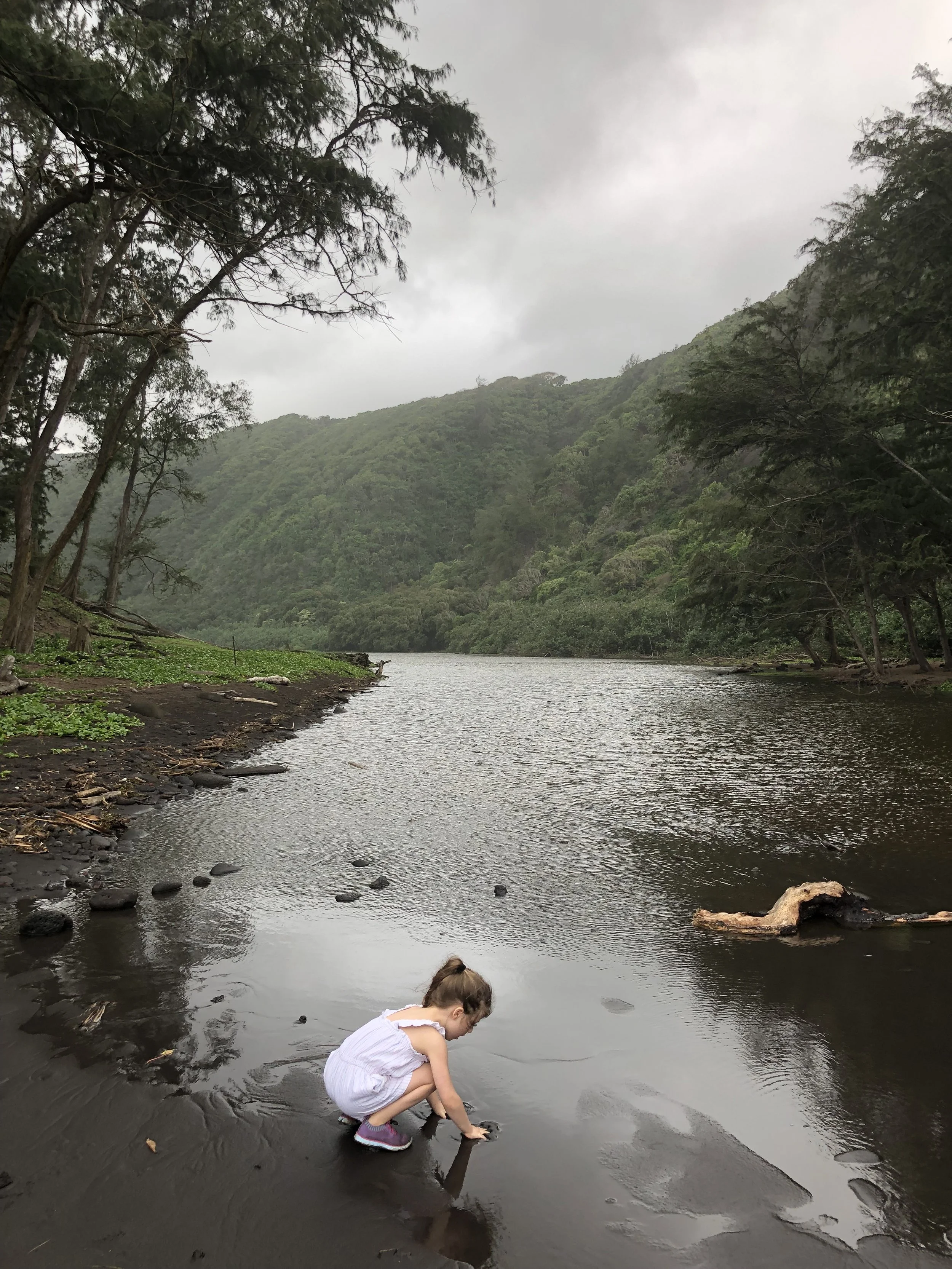
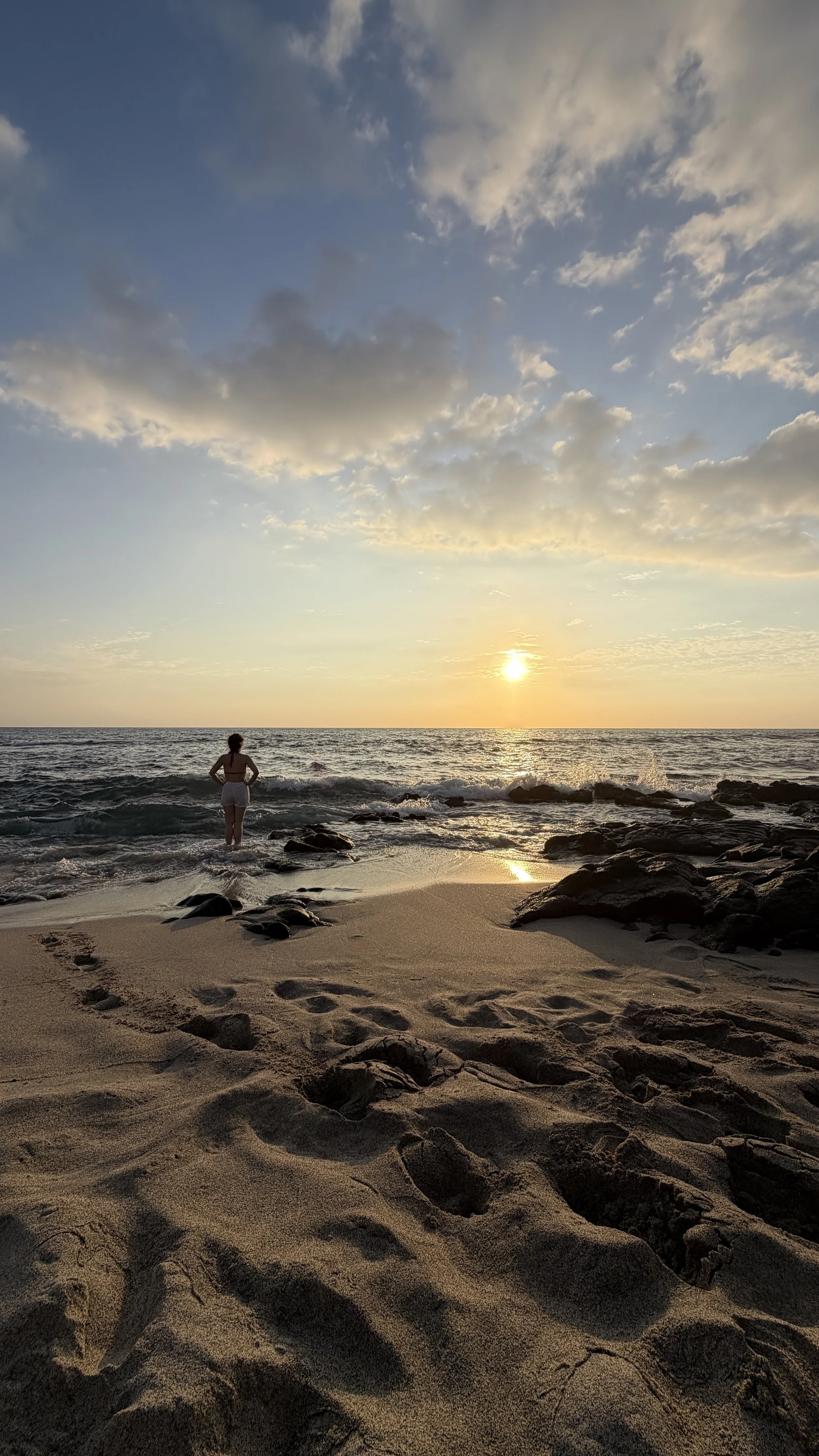
I’ve just returned from ten days on the big island of Hawai’i. Plenty of pool time, so much papaya, an erupting volcano, sea turtles, lava rock. It wasn’t a relaxing trip, but it was an incredible adventure.
I’ve come to see my travels as a parent, and especially as my kids grow older, as explorations more than anything. We watched documentaries in the evenings about the history of hula and the geology of the Hawaiian islands, to answer my daughters’ questions about the culture and landscape. We looked up local words and tried to weave them into our conversations. The girls became junior rangers at Volcano National Park. We immersed ourselves in ‘Hawai’i’. Not just the amenities, or the tourist infrastructure, but the Place, if we can consider a Place as living, which I do. A Place with histories, myths, language, other-than-human beings. A Place that speaks. I love Hawai’i because if you know how to listen, this is a Place that speaks with so much beauty.
I had hoped to bring home a piece of this Place, a small rock as a memento for a friend who had once lived in Hawai’i and grieved that she no longer did. She felt cut off from the land that she loved. I wanted to bring that land to her. I had planned to bring her a rock from the volcano when we visited, as she had spoken of the Hawaiian people’s deep spiritual connection to Pele, the Goddess of Lava, of the Volcano itself. I thought that would help her feel connected in some way too.
But I overheard a local woman in the market warning tourists against doing exactly that. I didn’t understand why. But I learned that taking rocks from the National Park is both illegal, and especially in Hawai’i, deeply disrespectful. Not only from the National Park, but from all land. Hawaiians believe that the land is interconnected. Everything is in relationship to everything else. The rocks, the shells, the sand, the coral, it belongs in Hawai’i. It is all part of this sacred Place. These are not things, not resources, nor features, they are living relatives. They give life to one another.
That struck me. I’ve often carried small rocks or shells home with me from significant trips, hoping to bring the memory with me. In fact, on this trip I was wearing a necklace I had made from a small piece of coral I found on this same island six years earlier. Micael had carefully drilled the tiniest hole through it, and I strung it together while I was pregnant with Noemie. It was a beautiful reminder of a Place that I connect with deeply.
I spent more time researching the restrictions on taking pieces of land from Hawai’i. No matter where I looked, the messaging was consistent, it was both illegal and culturally discouraged. I couldn’t believe I hadn’t heard this in over thirty years of visiting the islands. But more importantly, it made me ask myself whether the piece of coral I was wearing actually belonged there in Hawai’i instead of at home with me.
I know for most people this would be a non-issue. It was small, no harm was intended, let it go, move on. But I couldn’t. I see the way Hawaiians look at land, at Place, at family, at hula, at history, and I think they understand something most of us are deeply missing. I see this in indigenous cultures in many places, the ability to hold the ineffable in a kind of quiet knowing. I want to live that. Suspended in the sacred.
So I turned that piece of coral over and over in my mind, in my fingers, for days. My daughters had both gathered small mementos from a beach we’d visited, a shell, a piece of coral. I told them we had gathered it on protected land and we would need to return it. And we did. But still I was hesitant to return mine. I had history with it. It felt sacred to me for when I had found it, when I strung it, when I wore it. It felt like it belonged to me.
But the lesson for me to learn was that it didn’t. The land does not belong to me. It can’t. Not anymore than you can belong to me. To be in relationship with, means to understand the sovereignty of all life. Of both human and non-human others. Of everything. That may sound quaint in our culture that has so trained us to see everything as commodities, to break down even the parts of our own bodies into commodified labor. But most humans, most cultures everywhere throughout history have understood land in this way. Sacred relationship.
And I’m tired of the narratives that tell me to look at life as commodity. I want something deeper.
So I thought long and hard. And in the end, on our last day, we went to the beach and I cut the coral from that necklace and threw it back into the ocean. To roll in the waves and slowly break down into sand. To create habitat for creatures I don’t even know the names of, to hold together beaches for many feet to walk. I wanted that piece of the land to be in its Place. To be living its purpose as I want so much to live mine. It may have been insignificant if we consider only the practical aspects of that act. What impact can a one inch piece of coral have on an island of 4,028 square miles? An island of 266 miles of coastline? Insignificant. When I look at life as commodity.
But when I shift, and I look at life as Sacred, that act is immense. Because it was a choosing to be in right relationship with Place. To say that honoring the people, the land, and my own integrity in relationship to this place I was visiting, was more important than owning something, even something meaningful.
When I returned home, I tried to find a Hawaiian word or phrase that could encompass what I was feeling. I felt certain the language would have one. And it did.
kina’ole. It means to do the right thing, in the right way, at the right time, in the right place, to the right person, for the right reason, with the right feeling.
I would add to this, to do the right thing for the land as well. To be in right relationship in everything we are doing, always.
And what does this open up? Why do it? Well, I can say from my experience that this has moved me in a big way. I spent most of that last day crying on our long drive across the island to the airport. Not even sure all the reasons tears were coming, but it felt like things long pent up that were ready to be released. It felt like flow. It felt like grief in the most nourishing, healing way, as if I’d come home to myself somehow in a way that I hadn’t before known how to do. It felt like being in synchronicity with myself, with the land around me, with the people near me, with Life, with Place. It felt good. Or right. It felt like something I don’t quite have the words for. I felt held in something bigger than me.
Maybe it felt like trust. As if I’ve come to a place where I feel so safe, so known, so sovereign in my body and in the care of everything I’ve built around me, that I don’t need to hold things so tightly anymore. I can let go, and release, and not need so much to be ok. Because I’ve grown something more full to hold me. I can trust.
I’ve since returned to Seattle. I’m trying to see the land here as I do in Hawai’i. Full of Sacred Place. Pungent with meaning. It’s harder for me here. The dominant culture doesn’t carry these beliefs, and just flying in I see how much more land is covered by human presence and the impact that has on being able to feel the Presence of Place. But what shifted for me in Hawai’i is still reverberating. As if I’ve been tuned. I’m hearing differently, sensing differently. And so, to continue this practice, to learn to live in the ineffable, I keep asking myself…
What will keep me in sacred relationship in this moment?
And I keep listening.
✷
If you would like to explore how indigenous Hawaiians or indigenous North Americans understand themselves in relationship to sacred Place, I would recommend these books and documentaries:
Braiding Sweetgrass, by Robin Wall Kimmerer, visit here
Daughters of Copper Woman, by Anne Cameron, visit here
*there is some controversy over this book as it was written by a non-indigenous woman, but I still find the intention beautiful and valuable as a place to start conversation
Held by the Land, by Leigh Joseph, visit here
‘Hula is Hawaii’ documentary, available here
‘Hula Is More Than a Dance’ documentary, available here
© 2026 Briana Thiodet. All language and images are original and protected.